

Future instrument for studying black holes makes discovery in first observation
-
Topics
Uncategorized
-
Share


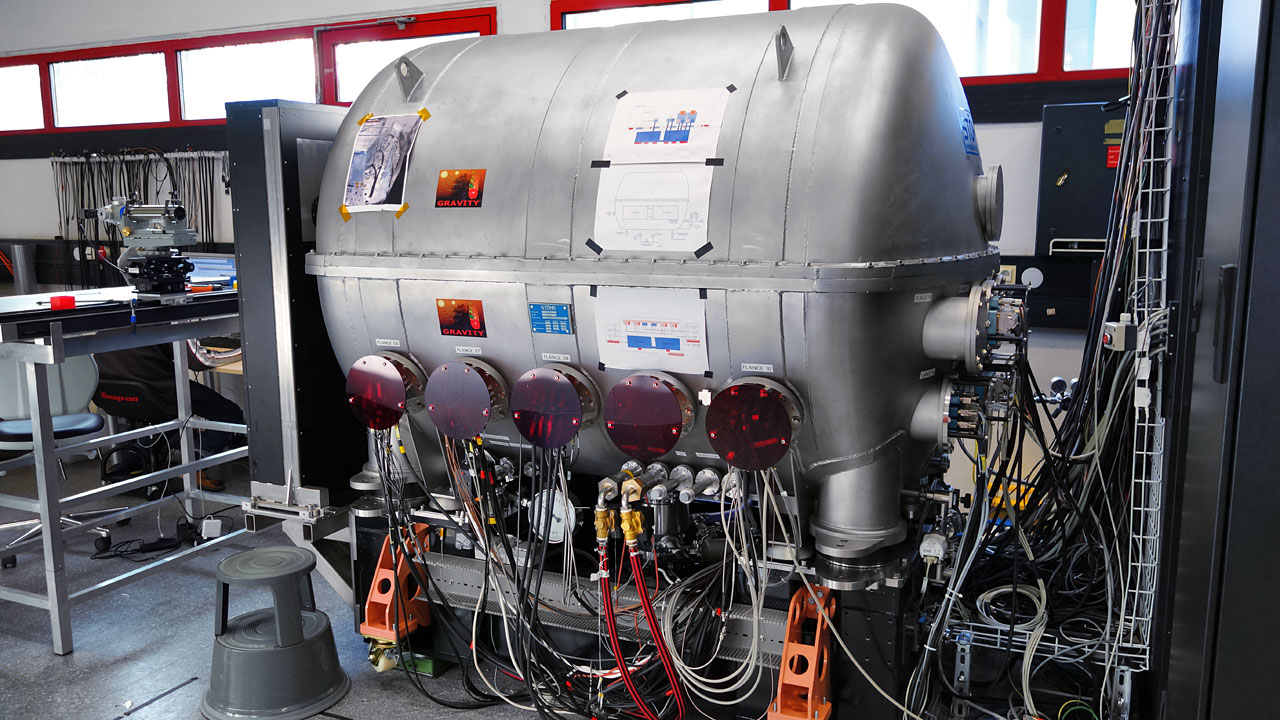
GRAVITY is the most powerful instrument installed to date on the Very Large Telescope Interferometer (VLTI), the world's most advanced infrared telescope, located at ESO's observatory in the Paranal Desert in Chile. GRAVITY's main objective is to study black holes. This week, ESO announced the first observations made by GRAVITY. A team from the CENTRA – Multidisciplinary Center for Astrophysics of the Universities of Lisbon and Porto participated in the construction of this powerful instrument.
Already considered ESO's scientific priority for the near future, GRAVITY combines the radiation captured by several telescopes to form a virtual telescope with a diameter of up to 200 meters. It uses a technique known as interferometry, which allows much more detail to be detected in images of astronomical objects than would be possible with a single telescope. In its first observation, it has already made a small discovery: one of the stars in the cluster located in the heart of the Orion region is a double star.

The Portuguese CENTRA team built the instrument's acquisition camera. This system tracks astronomical objects and corrects for residual aberrations introduced by the Earth's atmosphere and small mechanical vibrations of the instrument in the light beams that are combined, enabling the instrument to achieve exceptional accuracy.
After this phase, the Portuguese team will prepare for scientific exploration of the instrument, focusing on the study of the black hole at the center of our galaxy and the origins of stars and planets. Portuguese participation in the GRAVITY instrument was partially funded by the Foundation for Science and Technology (FCT).
Images, from top to bottom:
- GRAVITY — future black hole probe
- GRAVITY discovers new double star in the Orion system.
(Source: ESO – European Southern Observatory)