

13th Edition of L’Oréal’s Medals of Honor for Women in Science
-
Topics
Uncategorized
-
Share


(Versão em português disponível em breve)
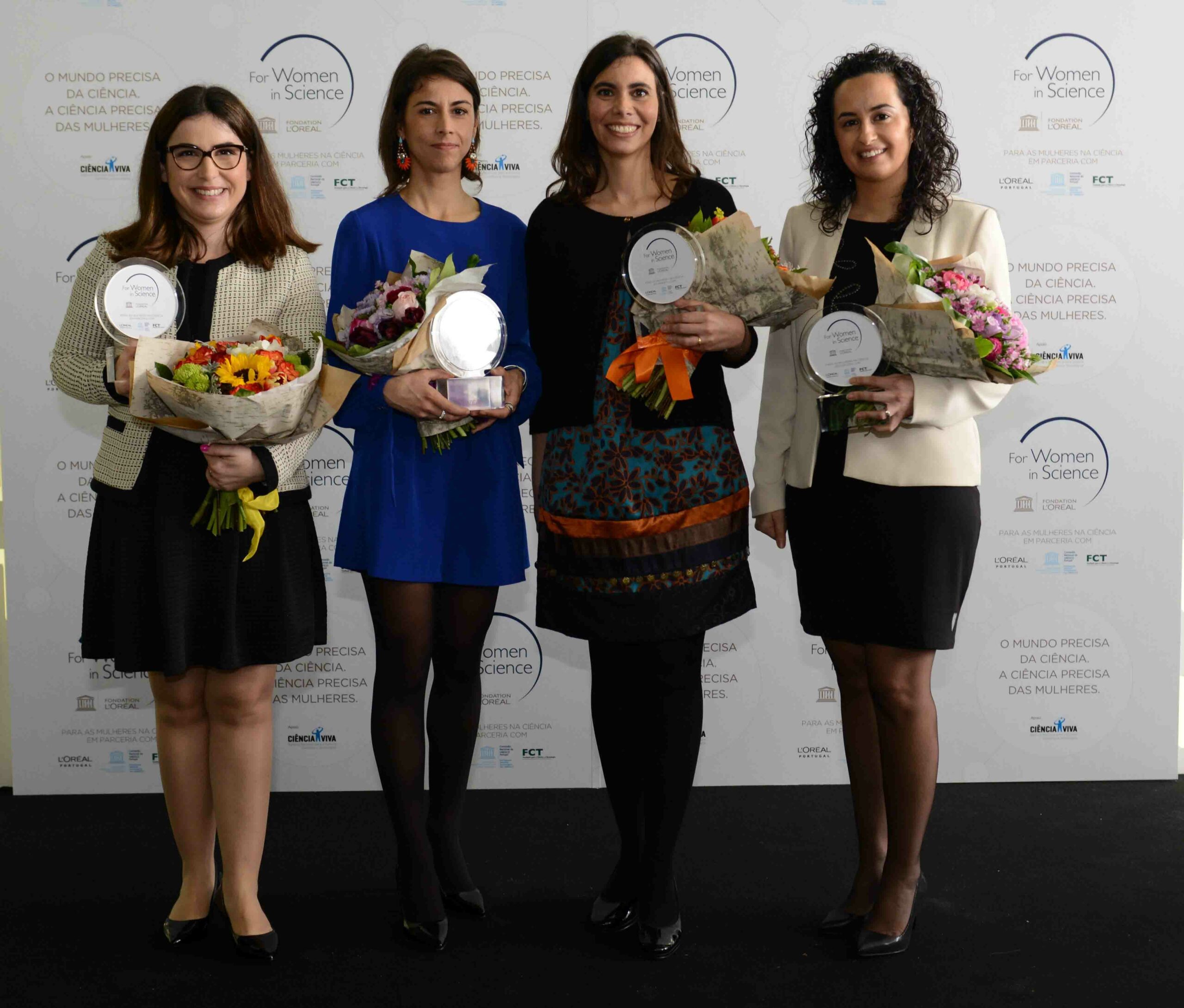
Ana Rita Marques, Isabel Veiga, Maria Inês Almeida, and Patrícia Baptista were the four young researchers who won the 13th edition of the "L'Oréal Portugal Medals of Honor for Women in Science," an initiative promoted by L'Oréal Portugal, in partnership with the National Commission for UNESCO, the Foundation for Science and Technology, and with the support of Ciência Viva.
The jury, chaired by Alexandre Quintanilha, evaluated 80 applications in this edition and decided to distinguish the work of four young Portuguese scientists who are conducting research in the areas of infertility, malaria, bone regeneration, and mobility, respectively. The award ceremony took place on Tuesday, February 7, at the Pavilion of Knowledge, and was attended by the President of the Republic, Marcelo Rebelo de Sousa.
This annual award from L'Oréal Portugal, worth €15,000, is aimed at young Portuguese scientists who are conducting research in Portugal, already hold a PhD, are aged 35 or under, and are carrying out original studies that are relevant to health and/or the environment. The award was established in 2004 and aims to motivate and support young scientists to continue their projects. To date, this award has recognized 41 researchers in Portugal.
About the award-winning researchers:

Ana Rita Marques (36), from the Gulbenkian Institute of Science (IGC), seeks to uncover the role of centriole coating in the correct regulation of these tiny structures responsible for cell division. Understanding how the absence or presence of this shield is regulated could open up new lines of research, with applications in the areas of female infertility, tissue regeneration, diseases related to embryonic malformations, and cancer.
She obtained her PhD at the IGC in the field of developmental biology (2007-11), and at the age of 31, after having her first daughter, she began her postdoctoral studies in the field of cell biology as a researcher at the same institution. In 2015, she became a mother again and currently remains at the IGC, in the Cell Cycle Regulation Group, under the guidance of Mónica Bettencourt Dias and with the support of the FCT.

Isabel Veiga (35), from the Institute for Research in Life Sciences and Health (ICVS) at the University of Minho, intends to investigate the factors and genetic mutations of the malaria parasite that make it resistant to the only existing therapy to combat this disease, which is responsible for nearly half a million deaths per year. Her study is crucial to anticipating the extent to which the current treatment will be effective and to increasing its effect and longevity.
She holds a PhD in Medical Sciences from the Karolinska Institute in Stockholm (2011), where she began studying the resistance of the malaria parasite to available treatments and continued her postdoctoral research. She has been collaborating for four years with Columbia University (USA) and ICVS on research into the malaria parasite.

Maria Inês de Almeida (33), from i3S – Institute for Research and Innovation in Health – University of Porto, studies non-coding RNA molecules, seeking to determine whether they are capable of "instructing" cells to regenerate tissue, particularly bone tissue, helping to curb diseases such as osteoporosis, treat congenital defects, or recover from injuries and surgeries.
She holds a PhD from the University of Minho and the MD Anderson Cancer Center at the University of Texas, where she studied the biological effects of microRNAs in colorectal cancer. In 2013, she began her postdoctoral studies at i3S, continuing to study the role of microRNAs and RNA molecules.

Patrícia Baptista (33), from the Center for Studies in Innovation, Technology, and Development Policies IN+ – Instituto Superior Técnico (IST), is developing a research project aimed at improving urban mobility through the development of a tool that effectively assesses the shortest, most economical, safest, least polluting, and least harmful routes to health, especially for users with greater mobility difficulties.
He obtained his PhD in Sustainable Energy Systems (IST) under the MIT Portugal Program (2011), focusing on the Impact Assessment of Alternative Technologies and Fuels in the Road Sector. He went on to do postdoctoral research at Associate Laboratory Energy, Transport, and Aeronautics (IST), assessing the Energy, Environmental, and Economic Impact of Communication and Information Technologies on Urban Mobility.