

FCT researcher leads discovery of the first stars in the Universe
-
Topics
Uncategorized
-
Share


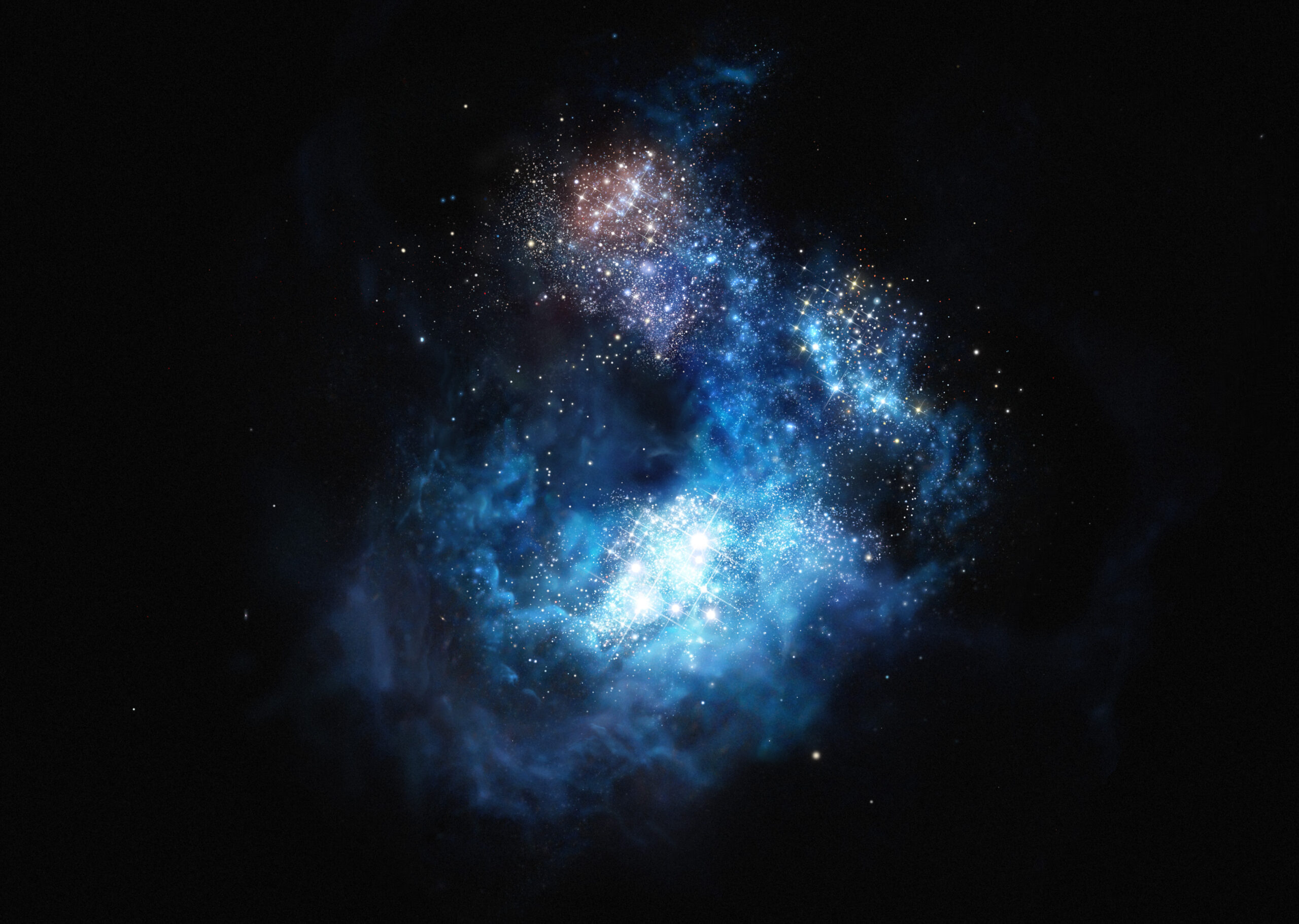
An international team led by astrophysicist David Sobral has discovered the brightest galaxy from the early Universe ever found, and has shown that this galaxy appears to contain examples of the first generation of stars to be formed. These discoveries confirm the long-standing theoretical prediction of the existence of these first-generation stars, which are thought to have formed from the primordial material of the Big Bang. These enormous, bright objects would have created the first elements necessary to form stars like the Sun, planets, and life as we know it today.
The first stars must have formed from elements that are known to have existed before stars existed: hydrogen, helium, and trace amounts of lithium. They would have been enormous (several hundred or even thousands of times more massive than the Sun), extremely hot, and transient, with a lifetime of only a few million years. No international search for physical evidence of their existence has been successful. Until now.
The team decided to take a different approach from other researchers, mapping large areas of the sky rather than focusing on a limited, in-depth study of a small area. They used the Very Large Telescope (VLT) at the European Southern Observatory (ESO), the W. M. Keck Observatory, the Subaru Telescope, and NASA/ESA's Hubble Space Telescope to observe the early universe, about 800 million years after the Big Bang.
David Sobral, who is also a researcher at Leiden University, explains, “We knew that the risk of looking where no one else looks was easily offset by unexpected discoveries (...) It was fantastic when we discovered the CR7 galaxy, the brightest ever found in the early Universe.” And the discoveries went further: "As we put the different pieces of the puzzle together, we realized that we had found something much deeper and that we were seeing, for the first time, a Holy Grail of astronomy—the first stars."
The Portuguese astrophysicist is extremely proud of his team's work and the support provided by FCT: "This discovery (and many others) was only possible in Portugal thanks to the FCT Researcher program, which I believe has the potential to help the country and its universities truly take advantage of FCT support (on par with the best funding agencies in the world). Without the Studentship was awarded by the FCT in 2007 to do my PhD in Edinburgh, it would be impossible for me to be coordinating my own team today and competing with the best in the world. I would also like to highlight the importance of Portugal being part of the ESO (and the ESA, for access to the Hubble Space Telescope) – without this, it would be impossible to obtain all the time we have been able to devote to this discovery.”
The team's findings (which includes researchers from Leiden University, the University of California, and the University of Geneva) will be published in the prestigious Astrophysical Journal. They have been included by ESO in the Top 10 discoveries in astronomy made using ESO telescopes.
Portugal in the ESO – 15 years
This year marks Portugal's 15th anniversary of membership of the ESO. Being one of the 16 member states of the "world's largest ground-based astronomical observatory" is recognized by researchers, funding agencies, and the government as central to the construction and sustainability of the country's small but highly productive space science community. At the public event organized by FCT to mark the anniversary, Tim de Zeeuw, Director General of ESO, welcomed Portugal's strong participation in ESO in terms of good use of telescope observation time (through Calls ), growing contribution to instrumentation, and greater involvement of national companies in ESO projects.
Paulo Garcia, Portugal's delegate to the ESO Council, reinforced these successes, reminding everyone that Portugal has a "winning agreement" with the ESO. The high scientific impact index in the field of space sciences and the ability demonstrated by research units in this area to attract European funding (71% compared to 35% for other units funded by the FCT) demonstrate the positive return on Portugal's 1% contribution to the ESO's overall budget.