

Science, Europe, and the Mediterranean at the Science 2017 meeting
-
Topics
Uncategorized
-
Share


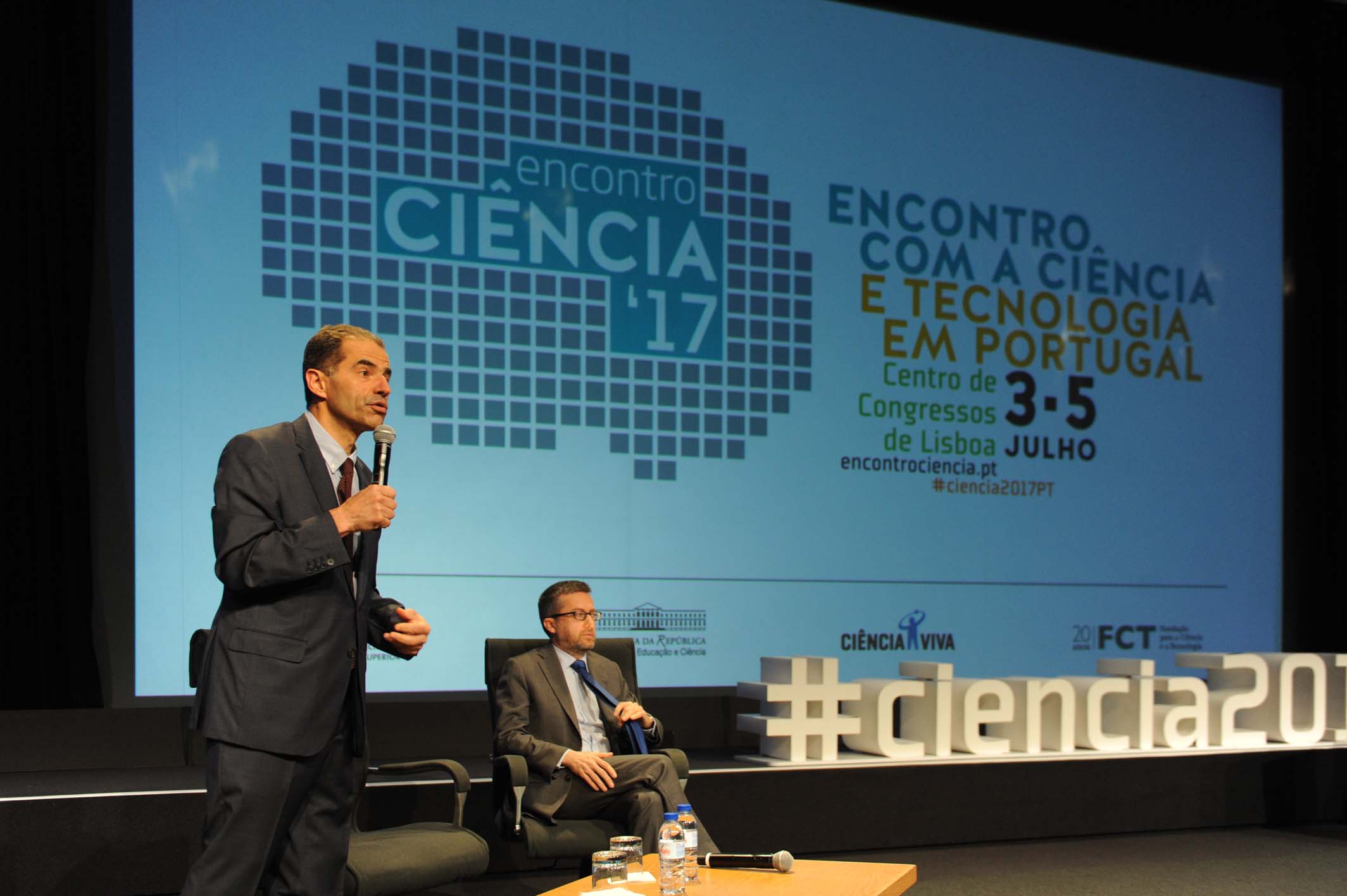
The last day of the Science 2017 Meeting, on July 5, opened with a plenary session on the theme "Science, Europe, and the Mediterranean."
The session was attended by EU Commissioner for Research, Science, and Innovation Carlos Moedas, Minister of Science, Technology, and Higher Education Manuel Heitor, President of the Parliamentary Committee on Education and Science Alexandre Quintanilha, and deputies from the five parties with seats in parliament represented on this committee.
In his speech, Minister Manuel Heitor referred to four critical messages for the future, which are intended as premises for this meeting: 1. Align – to respond to the tasks and challenges of the National Science and Technology Plan; 2. Open – towards an open science community that dignifies knowledge as a public good; 3. Strengthen – the scientific community at the scientific employment level, and the units and associated laboratories; 4. Diversify – the scientific community and the scientific system.

Commissioner Carlos Moedas, in turn, presented some findings from the LAB-FAB-APP report produced by the high-level independent group appointed by the commissioner and chaired by Pascal Lamy, which was made public in Brussels on Monday, July 3. The LAB-FAB-APP report outlines a vision and a set of strategic recommendations intended to enhance the impact of EU research and innovation in the future, based on a critical analysis of the evaluation of the results of the Horizon 2020 program for the construction of a post-2020 program. In his speech, the Commissioner pointed out three recommendations given by this report: 1. look at the whole, not the parts; 2. focus on the scientist, who is the decision maker and innovator; and 3. the tasks, that bind science to the citizen and align all the elements of the chain.
In the interventions of the members of the Parliamentary Committee on Education and Science, the common denominator was the concern everyone showed for the creation of legislation in parliament on various subjects, who understand that it should be increasingly based on studies produced by the scientific community.
Following these contributions, the meeting continued with a technical panel, attended by Vladimiro Miranda, from INESC-TEC at the University of Porto, with a paper on trans-Mediterranean cooperation and Portuguese affirmation with emphasis on Morocco, and Mário Carvalho, from the ICAAM of the University of Évora with a paper on agronomic strategies for increasing the production of irrigation water in the Mediterranean environment.
The final interventions of the session were by Nart Dohjoka, from the Science Diplomacy Program of the Royal Scientific Society of Jordan, and by Minister Manuel Heitor, who closed the session.