

The Portuguese Presidency of the Governing Board of the European University Institute comes to an end
-
Topics
International Research
-
Share


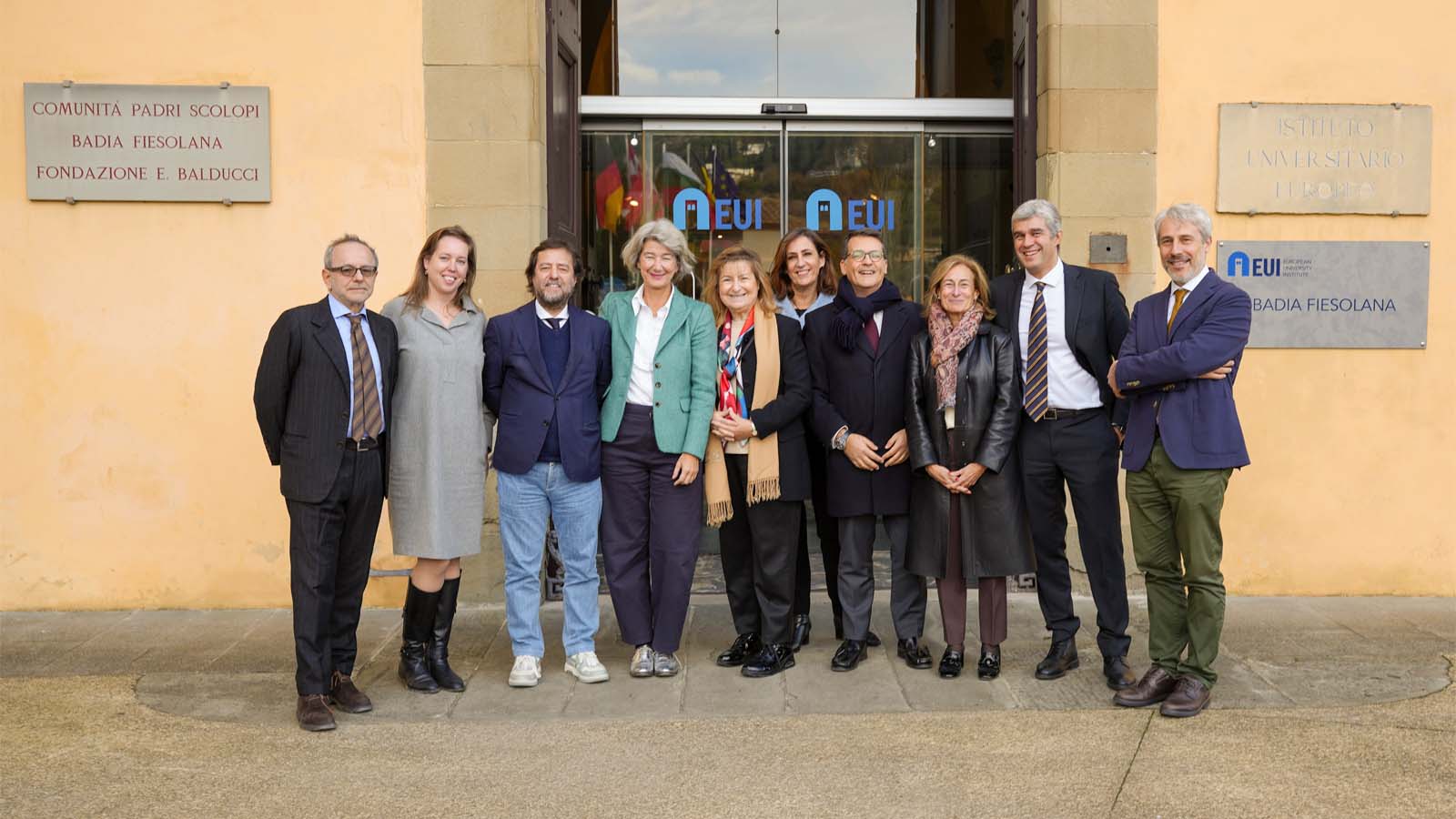
On December 4 and 5, in Florence, the Portuguese Presidency of the Governing Board of the European University Institute (EUI), which had been in place since the beginning of 2025, came to an end. The December meetings marked the end of a particularly important cycle for defining the institution's strategic guidelines, namely the approval of the EUI Strategy for 2026–2031, as well as the budget for 2026, which are key elements for strengthening the Institute's role in advanced research in the social sciences and humanities.
The approval of the new Strategy 2026–2031, which marks the Portuguese presidency, establishes a set of priorities that seek to ensure that the IUE remains at the forefront of knowledge in an increasingly digital age. Among the objectives defined, the following stand out: strengthening scientific excellence, investing in digital and computational capabilities, and promoting the public impact of the research produced by the institution. These measures seek to consolidate the IUE's position as an international reference in public policy analysis, European integration, digital governance, and contemporary social dynamics.
The Portuguese Delegation at the closing session included, in addition to National Academic Delegates Miguel Poiares Maduro and Maria das Dores Guerreiro, representatives from the Foundation for Science and Technology (FCT) and the Directorate-General for European Affairs of the Ministry of Foreign Affairs. This joint participation reinforces the national commitment to the IUE as an international organization and academic institution.
The EUI is a training and research institute at the highest university level, created in 1972 by six Member States of the then European Economic Community (Germany, Belgium, France, Italy, Luxembourg, and the Netherlands), reinforced the following year with the accession of Denmark, Ireland, and the United Kingdom, and welcoming its first researchers in 1976.
Portugal joined the EUI in 1989, when it signed the Convention establishing this international institution based in Florence. Since then, it has held the rotating presidency in 1992 and 2005. In 2025, Portugal once again held the presidency of the Institute, when national priorities included, among other objectives, the formal adoption of the Strategy for the period 2026-2031.
Today, the IUE is a unique international institute for advanced academic training that promotes excellence in research, focusing on doctoral and post-doctoral studies. It recruits students from all Member States, as well as from other parts of the world, with the aim of developing studies and research projects on European issues in the fields of Political and Social Sciences, Law, Economics, and History. It currently has 24 Member States: Austria, Belgium, Bulgaria, Croatia, Cyprus, Denmark, Estonia, Finland, France, Germany, Greece, Ireland, Italy, Latvia, Luxembourg, Malta, Netherlands, Poland, Portugal, Romania, Slovakia, Slovenia, Spain, and Sweden. Malta, the Netherlands, Poland, Portugal, Romania, and Sweden.
Photograph (from left to right): Armando Barucco (Secretary-General of the EUI), Josephine van Zeben (Provost for Education and Academic Staff Development, EUI), Miguel Poiares Maduro (President of the Governing Board in 2025 and national delegate of the Ministry of Education, Science, and Innovation to the Governing Board of the EUI), Patricia Nanz (President of the IUE), Maria das Dores Guerreiro (national delegate from the Ministry of Foreign Affairs to the IUE's Governing Board), Luísa Igreja (delegate to the Budget and Finance Committee of the IUE/Foundation for Science and Technology), Carlos Duarte (delegate to the Budget and Finance Committee of the IUE/Directorate-General for European Affairs, Ministry of Foreign Affairs), Maria João Botelho (Chair of the Budget and Finance Committee in 2025, Directorate-General for European Affairs, Ministry of Foreign Affairs), Roberto Nocentini (Chief Operating Officer of the EUI), Giacomo Calzolari (Provost for Research and External Relations, EUI).