

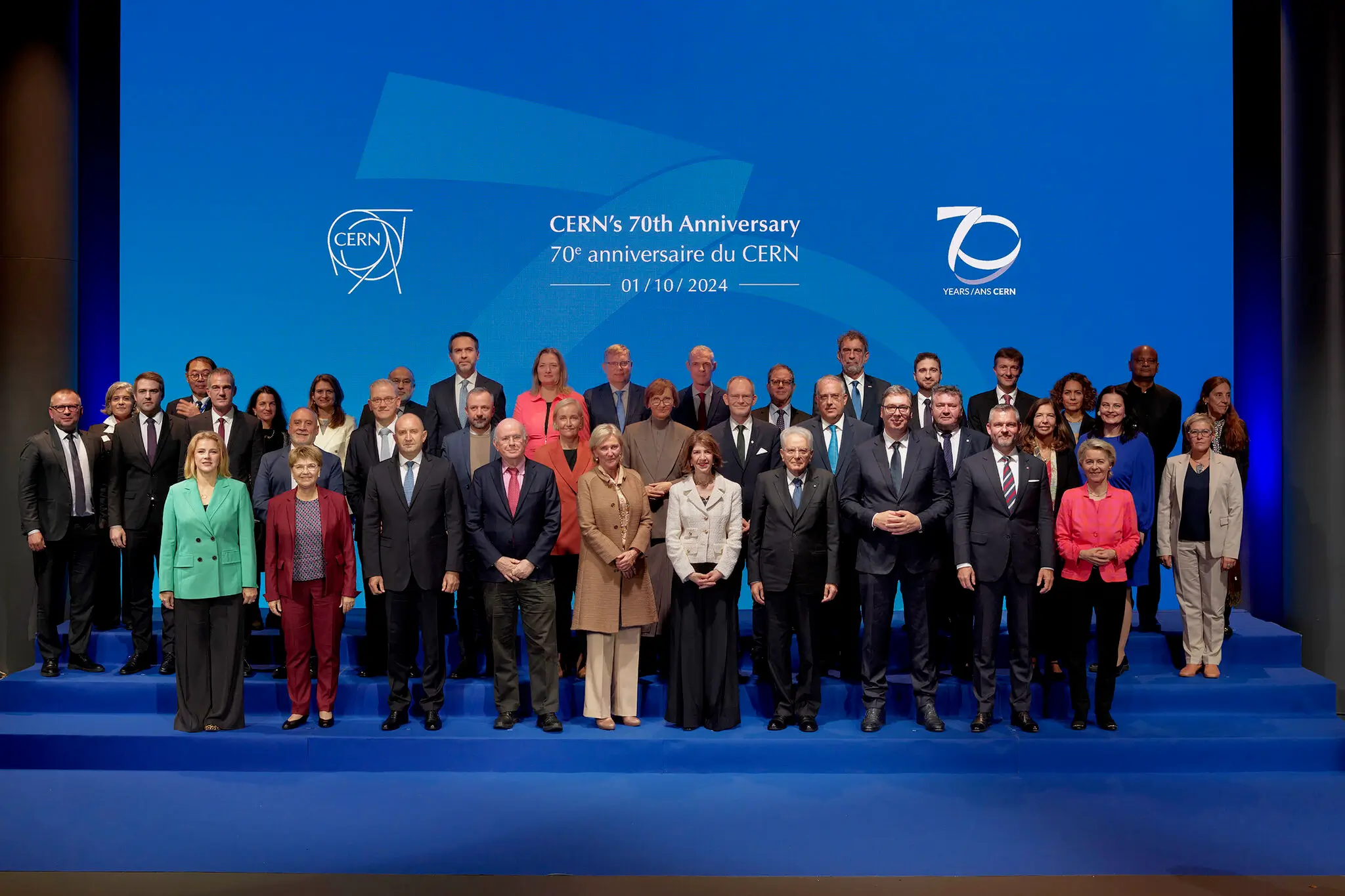
CERN was founded in 1954, in accordance with the Convention signed by the Founding Members. This scientific organization was created with the main objective of "promoting and collaborating between European countries in the field of fundamental research in High Energy Physics (HEP), in order to enable Europe to take the lead in this field." Since then, CERN has been the world's largest particle physics laboratory, located in the northwest region of Geneva, on the French-Swiss border.
CERN is funded by twenty-four Member States: Austria, Belgium, Bulgaria, Czech Republic, Denmark, Estonia, Finland, France, Germany, Greece, Hungary, Israel, Italy, Netherlands, Norway, Poland, Portugal, Romania, Slovakia, Spain, Sweden, and the United Kingdom. Estonia, Spain, Finland, France, Greece, the Netherlands, Hungary, Israel, Italy, Norway, Poland, Portugal, the United Kingdom, the Czech Republic, Romania, Serbia, Sweden, and Switzerland.
Cyprus and Slovenia are Associate Member States in the pre-accession phase. Brazil, Croatia, India, Lithuania, Pakistan, Turkey, and Ukraine also have Associate Member status.
The following have Observer status on the CERN Council: the European Union, UNESCO, Japan (for the LHC), and the United States of America (for the LHC and the HL-LHC). Russia's Observer status is suspended in accordance with the CERN Council Resolution of March 8, 2022, and the Observer status of JINR (Joint Institute for Nuclear Research) is suspended in accordance with the CERN Council Resolution of March 25, 2022.
Currently, CERN is the daily workplace for approximately 2,500 full-time employees from various cultures and nationalities, as well as 12,200 visiting scientists and engineers from around the world.
At CERN, the largest and most complex scientific instruments are used to create the conditions necessary for detecting and studying the basic constituents of matter and antimatter, which will enable the demonstration of fundamental theories of particle physics and the discovery of the elementary principles of the creation of the world as we know it. To generate these conditions, CERN has built and operates a set of particle accelerators, including the world's largest particle accelerator, the LHC. The LHC accelerates two beams of particles to high energies, which will collide at four points inside the accelerator, where colossal particle detectors are installed to record the results of these collisions. From materials science to information technology, from superconductivity to precision geodesy, particle physics demands extreme levels of quality, making CERN an important testing ground for various fields of technological innovation.
Portuguese Participation
Portugal's membership of CERN was signed in 1985, with effect from January 1, 1986. As a Member State, Portugal contributes annually to the annual operating costs of the infrastructure (around 1% of the organization's overall budget).
During negotiations for Portugal's accession, an Administrative Protocol was drawn up regulating the support of the Portuguese authorities for the development of the FAE and similar areas, namely through the financing of research projects managed by the FCT. The scientific benefit of national participation, taking into account the participation of the national scientific community of the FAE in CERN activities, is considered excellent. This scientific benefit includes the possibility of Portuguese teams accessing participation in experiments developed at CERN. In 2024, around 108 researchers were participating in some of CERN's experiments or research programs, such as CMS and ATLAS, installed at the LHC. Researchers in Portugal linked to CERN form teams in the field of particle physics and nuclear physics and represent various entities at the national level, including the Laboratory of Instrumentation and Experimental Particle Physics (LIP), the Technological and Nuclear Institute, and the Universities of Aveiro, Coimbra, Lisbon, and Porto, among others. The participation of these national teams in various CERN experiments has generated hundreds of international publications, presentations at international and national conferences, and several master's and doctoral theses. Approximately 65 other Portuguese nationals (with backgrounds in various fields, such as electronic engineering, electrical engineering, materials, and chemistry, among others) have permanent employment contracts in the organization's technical departments.
-
State
Active
-
Website
-
Contacts
Filipa Coelho
Industrial Liaison Officer (ILO) José Antão
Mario Pimenta
Ambassador to the Permanent Mission of Portugal in Geneva
-
Share



Updated on August 5, 2025