

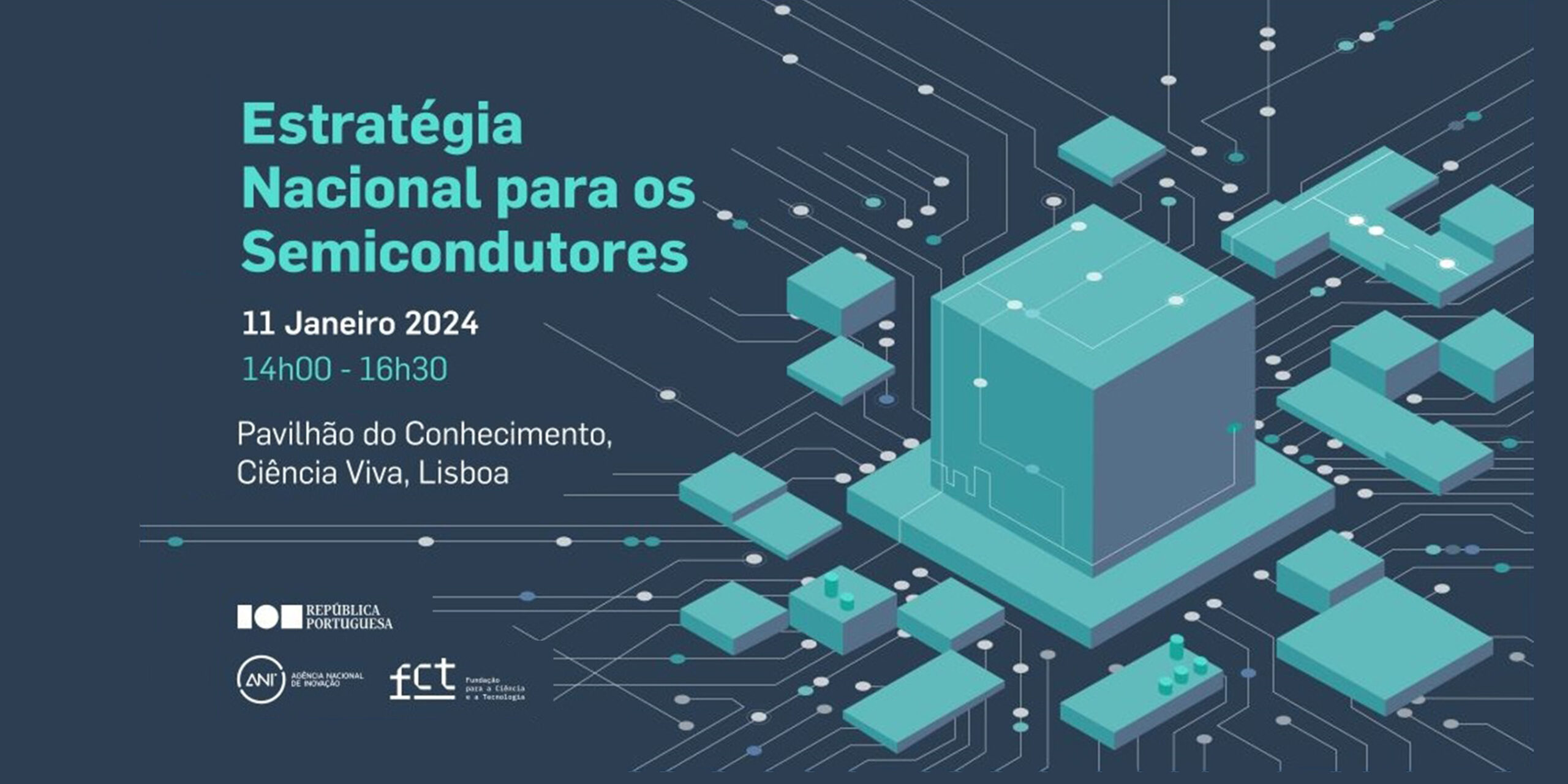
The National Strategy for Semiconductors, adopted by the Council of Ministers on December 7, 2023, and promulgated in Council of Ministers Resolution No. 12/2024 of January 8, will guide, among other initiatives, national participation in the activities of the Chips Joint Undertaking.
The Chips Joint Undertaking (JU) is an Institutionalized European Partnership under Horizon Europe, also co-financed by the Digital Europe Program for the period 2021 to 2027. Its members are the Participating States, the European Commission, and three private associations (AENEAS,Inside, and EPoSS) representing mainly the industrial community and research organizations. Portugal is one of the Participating States of the Chips JU through the FCT, in conjunction with the National Innovation Agency (ANI).
With the entry into force of the European Chips Act (European Regulation on Integrated Circuits), Chips JU replaces the Key Digital Technologies (KDT) partnership, ensuring the continuity of its activities and the implementation of its projects, but substantially expanding its scope. For more information on the European Integrated Circuits Regulation, particularly at a technical level, please refer to the relevantStaff Working Documentfrom the European Commission.
Chips JU's main objectives are to support research and innovation (R&I), as well as the design and production capacity of electronic and photonic components and systems, including processors, sensors, and other semiconductor-based devices, as well as their applications in a wide range of sectors (health, automotive/mobility, energy, agri-food, industrial production, etc.).
Chips JU will be instrumental in implementing measures to strengthen Europe's leadership in the development, design, and production of smaller, faster, and more energy-efficient integrated circuits (chips), including the development of quantum integrated circuits.
In order to develop and strengthen chip design, production, integration, and packagingcapabilities, support is planned for the development, upgrade, and creation of new Pilot Lines and a Design Platform, which will constitute the main infrastructure of Chips JU.
Chips JU will also contribute to educating, training, and retaining professionals with the necessary advancedskills in Europe. To this end, a network of Competence Centers is planned to be set up in the various participating states, which will also support access to Chips JU infrastructure, particularly for small and medium-sized enterprises (SMEs).
Chips JU is aligned with the twin green and digital transitions and contributes to the pursuit of the digital goals for 2030, enshrined in the "Digital Decade" vision.
Private members, represented through the three private associations listed above, make an important contribution to the Partnership through the definition of the ECS SRIA (Electronic Components and Systems Strategic Research and Innovation Agenda), which forms the basis for defining the R&I components of the Chips JU's annual work programs.
In accordance with the European Integrated Circuits Regulation, the implementation of Chips JU will be operationalized through two components: the "non-Initiative" component, corresponding to KDT's traditional Calls , and the "Initiative" component, corresponding to the creation of capabilities and infrastructure (Pilot Lines, Design Platform, Competence Centers, etc.).
Chips JU's activities will be co-financed by the European Union up to a maximum of €4.175 billion via Horizon Europe and the Digital Europe Program, with commensurate co-financing by the Participating States and a minimum contribution from private members of €2.511 billion.
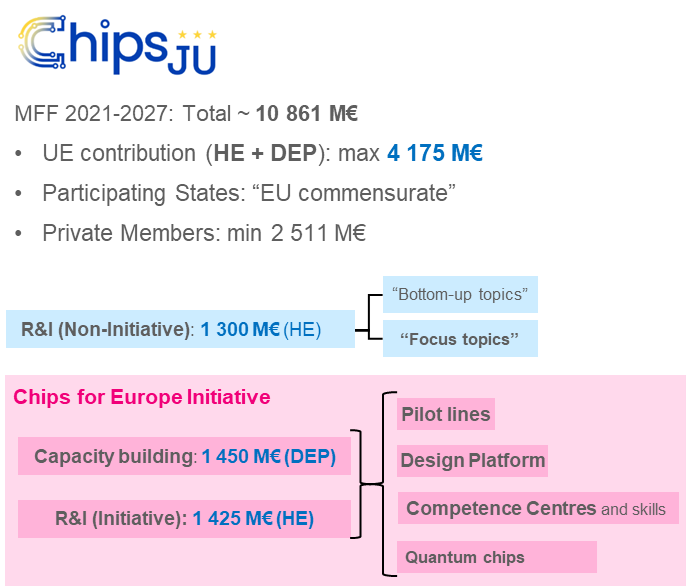
Chips JU will continue to include "focus topics" in its work programs.focus topics) that aim to respond to the urgent need to address weak links in innovation value chains in Europe and contribute to the strategic objectives of the "Digital Decade."
Chips JU should align itself in a complementary manner with theEuroHPC JU Partnership in the area of high-performance computing, for example, in the development of RISC-V processors and quantum computing.
There is also strong complementarity with the activities ofCluster 4 – Digital, Industry, and Space, and the European Innovation Council (EIC) of Horizon Europe and the Smart Networks and Services JU Partnership in the area of communication networks, as well as with other European Commission initiatives, such as theAlliance on Semiconductor Processors and Technologies.
To improve financial support for companies (such as start-ups and SMEs) with needs in starting up and scaling up their activities, a Chips Fund, financed through the Digital Europe Program.
Calls JU Calls should also be viewed in conjunction with the opportunities for support for the European ECS (Electronic Components and Systems) community, made available through the Eureka Xecs Cluster, whose program content is also associated with the ECS SRIA.
Calls
Calls 2021Calls – check the results here.
Calls 2022Calls – check the results here.
Calls 2023Calls –see the Calls page Calls results here.
Calls JU 2024 – see the Call page Call results here.
For questions related to national participation in Calls and KDT Calls , Chips JU Calls , and Competence Center Calls , particularly regarding the co-financing mechanism through FCT, please use the FCT contacts listed on the page.
-
In order to ensure alignment with the various components of Horizon Europe, including other Horizon Europe partnerships, as well as EU programs and initiatives in the field of digital technologies, the Portuguese Delegation to the Governing Board and Public Authorities Board of Chips JU is composed of the following representatives from FCT and the National Innovation Agency (ANI):
-
State
Active
-
Website
-
Share




Updated on July 14, 2025