

Presentation
The PRIMA Partnership was launched at the 2nd Euro-Mediterranean Conference of Ministers of Research and Innovation on May 4, 2017, in Valletta, Malta, through theDeclarationon "Strengthening Euro-Mediterranean Cooperation through Research and Innovation" (resulting fromthe Barcelona Process, 1995).
Highlights
Calls 2026Calls are now open; proposals must be submitted in two phases by 12:00 p.m. (Mainland Portugal time)
- Section 1: Phase 1 – May 15, 2026 | Phase 2 – October 7, 2026
- Section 2: Phase 1 – May 15, 2026 | Phase 2 – September 29, 2026
PRIMA Information Session on the Calls (online) – PRIMA Infoday, taking place on March 26. Register here.
Calls History
Calls 2024 Calls : Section 1; Section 2
Results of Calls from 2018 to 2021
Projects with Portuguese coordination and participation from 2018 to 2023
You can find all the information about projects funded under the PRIMA Partnership, including projects involving Portuguese researchers, in the PRIMA Intelligent Analytical Tool, a Power BI app that analyzes various performance indicators for the Partnership. NOTE: the data contained in this tool relates to proposals under consideration for funding and not to established contracts, either in terms of budgets or partners.
Communication and Dissemination Rules for Funded Projects
You can consult the communication and dissemination rules for funded projects via the following links:
- Funded projects Section 1: communication and dissemination standards;
- Funded projects Section 2: communication and dissemination rules and rules on information and publicity for beneficiaries (funding exclusively from national funds).
Partnership Development
ThePRIMA Partnership resulted from the development of the Euro-Mediterranean Partnership (also known as the Barcelona Process). Established in 1995 with the aim of promoting peace, stability, prosperity, and dialogue between cultures in the region, this process saw the establishment of the Union for the Mediterranean (UfM) in 2008, of which all European and UfM states are members. In turn, it also contributes to the European Neighborhood Policy, revised in 2011, and to Scientific Diplomacy in the Mediterranean and Europe.
The first step towards consolidating an ambitious proposal for an initiative in the field of science, technology, and innovation was taken at the 1st Euro-Mediterranean Ministerial Conference on Research and Innovation, held in April 2012 in Barcelona, Spain. The principles of co-ownership, mutual interest, and shared benefits were particularly emphasized in this proposal.
The Informal European Council of Ministers for Science, Technology, and Innovation, held in June 2012 in Nicosia, Cyprus, led to the formation of a group of European countries that began informal discussions on launching a joint initiative with Mediterranean partner countries. This initiative would be based on national funds from participating states and the European Union's framework program for science and innovation. The reference point for this initiative would be the instrument provided for in Article 185 of the Treaty on the Functioning of the European Union (TFEU), a program common to the States and the European Commission, with funding by the parties.
Finally, the initiative was launched at the 2nd Euro-Mediterranean Ministerial Conference on May 4, 2017, in Valletta, Malta, through the Declaration on "Strengthening Euro-Mediterranean Cooperation through Research and Innovation."
PRIMA Partnership Proposal
On December 22, 2014, a Partnership proposal was submitted to the European Commission, with national cash commitments amounting to €211.5 million, while contributions in kind were estimated at around €123 million.
Following an impact assessment, in July 2016 the European Commission decided to prepare a legislative proposal for co-decision between the European Council and the European Parliament with a view to establishing a program under Article 185 TFEU, in accordance with the wishes of the participating countries. The decision, taken on July 4, 2017, establishes the allocation of no more than €220 million in contributions under the H2020 Framework Program to projects with varying levels of technological readiness that meet the objectives set out in the Strategic Research and Innovation Agenda, in addition to support for the implementation structure. This contribution will be granted over 10 years (between 2018 and 2028) and includes an indicative global sum of €440 million. The participating countries areAlgeria, Cyprus, Croatia, Egypt, France, Germany, Greece, Israel, Italy, Jordan, Lebanon, Luxembourg, Malta, Morocco, Portugal, Slovenia, Spain, Tunisia, and Turkey.
The executive structure takes the form of a foundation under Spanish law. Established on June 19, 2017, the foundation operates in Barcelona, in conjunction with the Union for the Mediterranean, which is based in that city. The decision to locate the PRIMA Foundation's headquarters in this way is linked to the desire of the participating countries to foster significant synergies for the Euro-Mediterranean region with that organization, and vice versa.
Recent Developments
In 2023, Bulgaria joined PRIMA.
PRIMA (2018-2028), funded by the Horizon 2020 framework program, planned to launch Calls from 2018 to 2024, with monitoring and evaluation of funded projects scheduled from 2024 to 2028. However, in 2023, following the positive results of the first evaluation of the program, the countries participating in PRIMA expressed their interest to the European Commission in continuing with three more Calls , from 2025 to 2027. The European Commission granted the request and made efforts to allocate funds from the Horizon Europe framework program (not previously planned) for this extension period, a process that was approved by the Council and the European Parliament in April 2024. Negotiations are still ongoing, which has led to a delay Calls the Calls compared to the established annual calendar.
Meanwhile, a coordination and support action, coordinated by the PRIMA Secretariat – Future4PRIMA and in which FCT participates, was funded by the European Commission and began in January 2024, with the aim of preparing the future of PRIMA after 2028.
Strategic Research and Innovation Agenda (2018–2028)
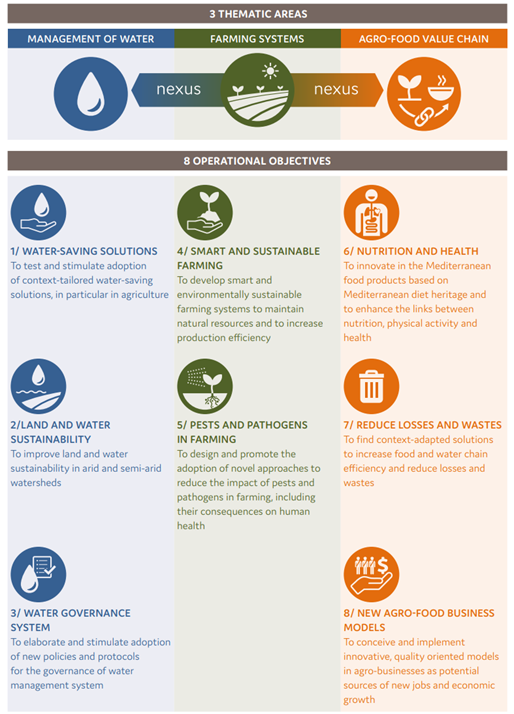
PRIMA focuses on food systems and water resources, while ensuring flexibility on the part of the countries involved. The full version can be downloadedhere. The three thematic areas and their respective objectives are:
1. Water management
- Test and encourage the adoption of water preservation and conservation solutions appropriate to each context, particularly in agriculture;
- Improving soil and water sustainability in semi-arid Mediterranean basins;
- Develop and encourage the adoption of new policies and protocols for the governance of water management systems.
2. Agricultural systems
- Develop smart and sustainable agricultural systems to conserve natural resources and increase production efficiency;
- Design and promote the adoption of new approaches to reduce the impact of pests and pathogens on agriculture, including the consequences for human health.
3. Agri-food value chain
- Innovate in Mediterranean food products based on the heritage of the Mediterranean diet, strengthening the link between nutrition, physical activity, and health;
- Finding context-specific solutions to increase efficiency in the food and water chain, reducing losses and waste;
- Design and implement innovative, high-quality models in agribusiness as a potential source of employment and economic growth.
Representation of the three thematic areas in research and innovation and their interconnection. Other cross-cutting topics include soil sustainability, food security, the digital revolution, socioeconomic research, and stakeholder involvement and capacity building.
PRIMA Corporate Video
-
State
Active
-
Website
-
Contacts
Silvia Silva
Rosário Costa
-
Share









Updated on March 23, 2026